
Why Kitchen Renovation Stress Can Wreck Your Sleep — and What Helps
There’s a particular kind of tired that comes with a home renovation. It’s not the good tired, the one that comes after a long day and ends with a heavy head hitting the pillow. It’s the wired, restless kind — the sort that keeps you staring at the ceiling running through tomorrow’s delivery schedule, wondering whether the plumber is actually coming this time, and whether the dust sheets will hold up over the sofa for one more night.
A kitchen renovation touches your whole home’s rhythm, not just the room itself. It’s where the day starts and ends for most families — the kettle, the packed lunches, the last cup of tea before bed. When that space is in chaos, it has a funny way of following you upstairs. Here’s why kitchen renovations are so disruptive to sleep, and what actually helps.
1. Uncertainty is the real sleep thief, not the mess
Dust and boxes are annoying, but what actually keeps people awake is not knowing what happens next. Will the units arrive on time? Is the wall behind the sink actually straight enough for the new cabinets? Who’s coordinating the electrician and the tiler so they’re not both turning up on the same Tuesday? A clear, fixed schedule — agreed before work starts rather than figured out as you go — removes most of that mental noise. When you know exactly which day the plumbing goes in and which day it’s cabinets, your brain has far less to chew on at 2am.
2. A drawn-out project keeps the stress running for weeks
Renovation stress compounds. One disrupted evening is manageable; six weeks of them wears a family down. This is often where the choice of installer matters more than people expect. Flat-pack kitchens in particular have a reputation for dragging on when the person fitting them isn’t experienced with the system — the METOD system, for example, needs precise wall drilling and exact cabinet sequencing, and getting it wrong means doors that won’t hang straight and drawers that stick.
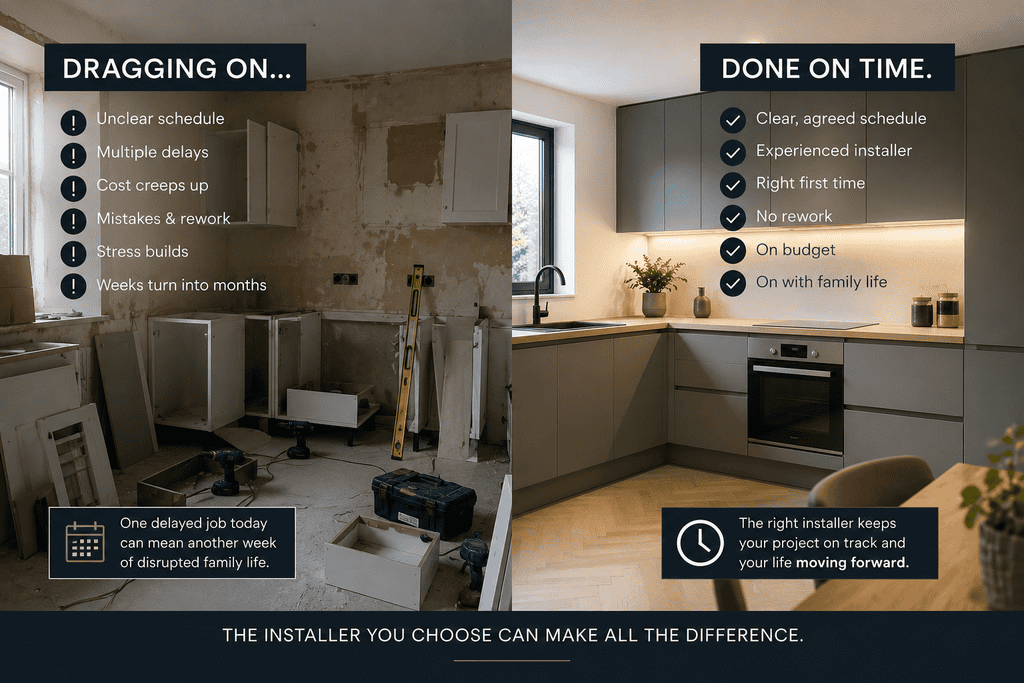
Booking an established IKEA kitchen fitting service rather than relying on a general handyman tends to keep the whole project to a realistic, agreed timeframe instead of stretching into an open-ended one.
3. Noise doesn’t stay downstairs

Drilling, sawing and hammering during the day is one thing. What disturbs sleep is when a rushed schedule pushes noisy work later into the evening because the team is behind, or when snagging issues mean tradespeople are back again the following week to fix something that should have been right the first time. A team that manages first fix, cabinet installation and finishing in the right order, with proper snagging built in before they call the job done, avoids the drawn-out back-and-forth that turns one disruptive week into three.
4. A kitchen you can’t use adds an extra layer of tiredness
When the kettle, the fridge and the sink are all out of action, even small evening routines get harder — making a warm drink before bed, prepping tomorrow’s breakfast, the ordinary things that quietly signal to a household that the day is winding down. It sounds minor written down, but when those small rituals disappear for weeks on end, evenings start to feel unstructured, and unstructured evenings rarely lead to an early, settled night. Planning ahead for a temporary setup, even just a kettle and a cool box in another room, keeps those small rituals intact while the real kitchen is being fitted.
5. Budget worry keeps minds racing after lights out
Nothing disturbs sleep quite like an invoice you weren’t expecting. Renovation costs that creep up mid-project — extra charges for plastering, for levelling an old floor, for a plumbing issue nobody flagged beforehand — are a common source of late-night worry. A fixed price agreed after a proper home survey, with any likely extras flagged honestly in advance, means there’s one less thing to lie awake calculating.
6. Trying to manage every trade yourself is exhausting
Coordinating a plumber, an electrician, a plasterer and a tiler around your own work and family schedule is a job in itself, and it’s often the background admin — not the physical mess — that leaves people mentally drained by bedtime. A single team managing every trade under one project, rather than a string of separate bookings, takes that coordination off your plate entirely.

This matters just as much for homeowners taking the flat-pack route. DIY kitchen installation brands are popular precisely because they keep costs down, but the units still arrive unassembled and need to be fitted in the right sequence — cabinets levelled before worktops are measured, plumbing positioned before units go in. A fitter who already knows the range removes the guesswork, so the project runs to the timeline you agreed rather than the one that emerges as problems surface.
7. An unfinished kitchen is a visible, daily reminder of everything left to do
Half-fitted cabinets and taped-off sockets are a constant prompt that there’s more to sort, and that kind of low-grade visual stress tends to follow people through the evening. A realistic finish date, with proper handover, snagging and a final walkthrough rather than tradespeople trickling off site over several loose ends, gives a household a clear point where the project is actually, genuinely done — which does more for a good night’s sleep than any amount of tidying up dust sheets.
The bigger picture

A kitchen renovation will never be entirely restful — it’s disruptive by nature, and a certain amount of upheaval simply comes with the territory. But most of the sleep-disturbing stress isn’t the sawdust; it’s the uncertainty, the open-ended timeline, and the sense of managing too many moving parts alone. A properly planned, fixed-price installation with one team overseeing every trade, a realistic schedule and proper snagging built in goes a long way towards giving your evenings — and your sleep — back while the work gets done. Choose well at the start, and the whole project feels less like something happening to you and more like something you’re simply waiting out.