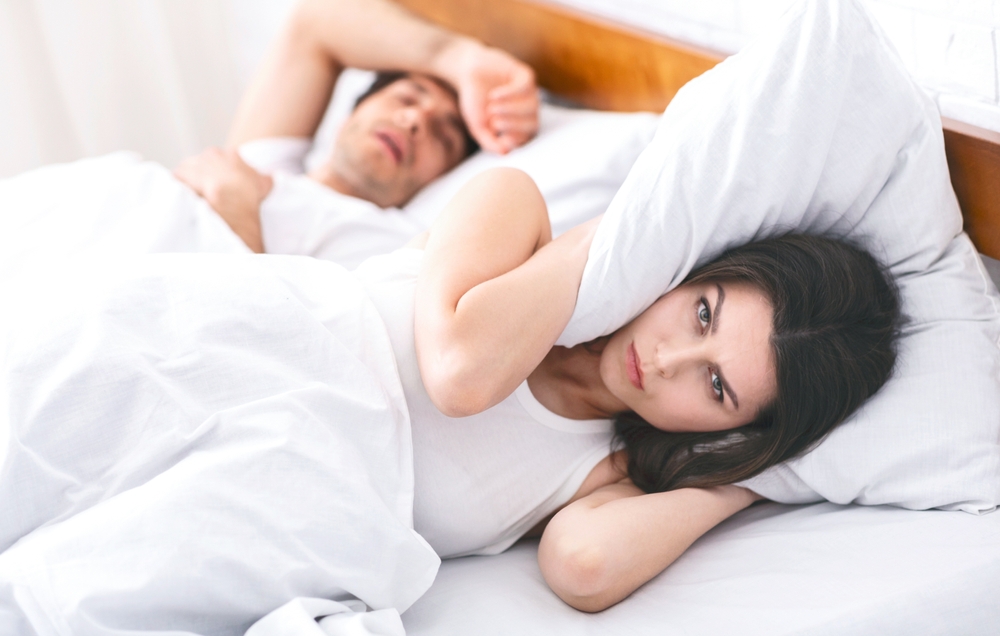
Snoring has long been a point of contention for partners when it comes to getting restful shut eye, with nearly one in ten admitting to considering splitting up with their partner because of it [1], while 38% of men and 36% of women cite snoring as the main reason for sleep divorce.[2]
At the moment interest in seeking remedies is on the rise, with snoring related search terms on Google seeing huge uplift over the last few months. Searches for ‘snoring remedies’ increased by 128% in the UK over the past three months, while searches for ‘snoring mouthpiece’ grew by 50%. [3]
Snoring can prevent your partner from getting a good night’s sleep, and in a small proportion of cases, snoring can be the sign of underlying health problems. To keep you and your loved one healthy and happy, sleep expert at MattressNextDay, Martin Seeley, shares advice on how you can minimise snoring.
Why do we snore?
Martin said: “Snoring is the sound of your soft palate and other tissue in the mouth, nose and throat vibrating. If there’s a blockage – whether that’s because of blocked sinuses, the throat being slightly closed due to the angle of the head and neck, or a range of other reasons – it can cause this soft tissue to vibrate.
“The type of snoring will indicate which area of soft tissue is vibrating. A soft, gentle snore indicates that your nasal passages are blocked, while a deep, loud snoring sound is a sign that the back of the throat is blocked.”
6 tips to help prevent snoring
In many cases, snoring can’t be ‘cured’, but it can be managed. Here are a few tips to reduce the likelihood of you or your partner snoring:
1. Sleep on your side rather than your back
Martin shared: “If you sleep on your back, you’re more likely to snore than those who sleep on their sides. The reason back-sleepers snore is that the tongue, neck tissue and chin press down on the airways, disrupting airflow and creating turbulence, causing soft tissue at the back of the throat to vibrate. Switching to side sleeping helps keep the pressure off your airways and therefore minimises the chances of snoring.”
2. Try and quit smoking or vaping
“If you’re a smoker, not only does it affect your long-term health, but it could be making you snore, too. Cigarette and tobacco smoke irritates the airways and the throat which can cause swelling. A build-up of catarrh also blocks not just the throat but the nasal passages which interrupts the flow of air and causes the soft tissue to vibrate.
“Vaping also causes irritation. In fact, the first controlled study into vaping’s long-term effects has been published this week, showing that vaping may be more harmful than smoking and cause even more irritation. Vaping can cause dryness in the throat due to ingredients like propylene glycol, which draws moisture out, making the tissues more prone to vibration and contributing to snoring sounds. Nicotine also relaxes the muscles in the throat, potentially causing airway collapse or partial obstruction.
“So, if you do smoke or vape, try to quit or avoid doing so before you go to bed. This should give your throat a chance to relax. ”
3. Avoid alcohol before you go to sleep
“Avoid drinking alcohol before you go to sleep because alcohol relaxes the muscles in the throat, which removes the rigidity around the airways and sets off the vibrations in the soft tissue once again, triggering a snoring session. You should try not to drink alcohol at least 3 hours before going to sleep to avoid sleep related issues.”
4. Maintain a good diet
“A healthy diet and avoiding being overweight are beneficial in so many ways, including cutting down on snoring. If you’re overweight, the fatty tissue that builds up around the neck and throat can press down on your airways when you’re asleep. This is why people who are overweight tend to snore more.
“By reducing your weight and keeping to a healthy lifestyle, you can improve both your breathing and general well-being. It can also help in developing better sleep patterns as they are less likely to be interrupted by snoring.”
5. Get new pillows
“Something as simple as buying new pillows could make all the difference to your snoring. Just like any other bedding, pillows can gradually accumulate dust, skin flakes and pathogens that can trigger a reaction such as rhinitis. One of the symptoms of this is snoring. So, consider replacing any tired, flat old pillows with something newer more hygienic ones.
“Hypoallergenic pillows will cut down on the number of fine particles around your nose and mouth, making it less likely that you’ll react to dust and general canker.
“The position and shape of your pillow can also make a big difference. If your pillow isn’t giving you the right support, then you could be blocking off your airways and causing the soft tissue in your throat to vibrate. Pillows should be comfortable, but not too plumped up. A new study by M&S revealed that Gen-Z opt for seven pillows! [4] Reducing the number of pillows you use to just one could solve the problem and prevent a blocked airway.”
6. Look into the possibilities of surgery
“Sometimes, snoring is caused by a medical condition such as sleep apnoea, which may require intervention. This can range from oxygen masks that are worn over the mouth and nose at night, to full-blown surgery.
“Enlarged adenoids at the back of the nose can block the airflow and cause snoring. This is a last resort for most people as surgery of this kind is drastic, invasive, and not without risks – it may not even sort the problem at all.
“There are also various devices on the market that can help, from something as simple as a sticking plaster that goes across the nose and opens up the nostrils, through to ionisers and a wide range of other implements that may (or may not) help.”
Does an anti-snoring mouthpiece work?
With 265k searches for anti-snoring device on TikTok, Martin weighs in on whether the popular device actually works.
Martin said: “No anti-snoring device can be guaranteed to stop snoring, but these devices certainly will reduce snoring as its main function is to keep your airways open.
“The mechanism works by moving the lower jaw forward during sleep, which also keeps the tongue forward, helping to keep the airway open and preventing the tongue from blocking it while tightening the soft tissues and muscles of the upper airway which stops vibrations.”
For more information on how to prevent snoring and which anti-snore bedding and pillows are right for you, please visit: https://www.mattressnextday.co.uk/snooze-news/post/how-to-stop-snoring-while-sleeping#do_antisnore_pillows_work_